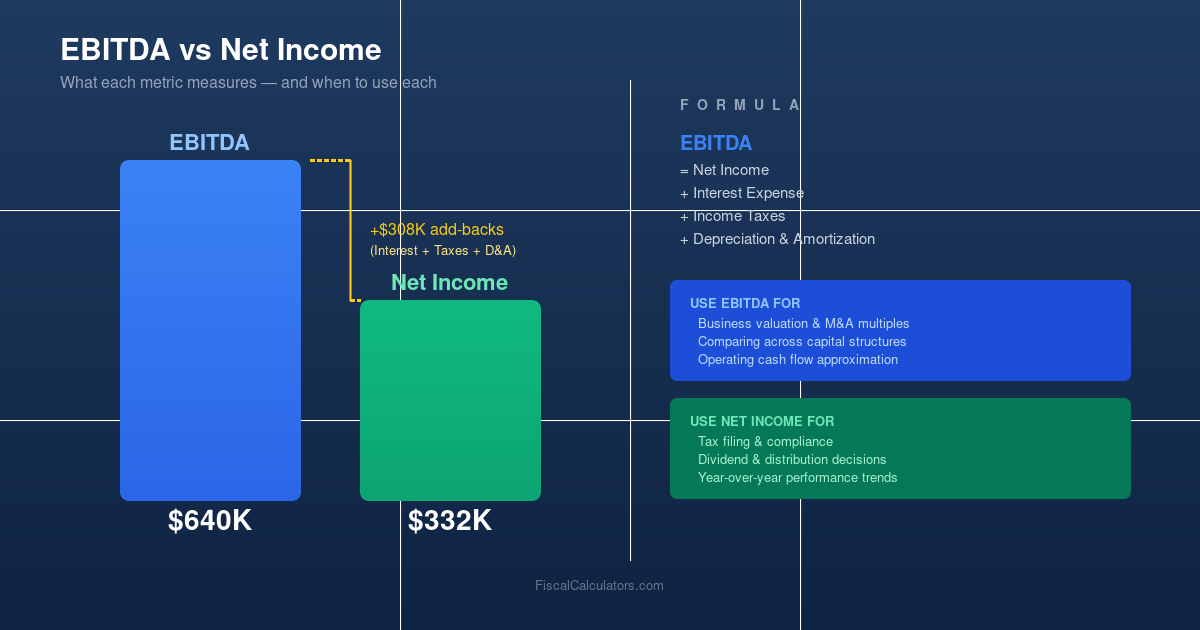
EBITDA and net income both appear on financial statements and both claim to measure business profitability — yet analysts, lenders, and buyers routinely use one and ignore the other depending on context. Understanding what each metric actually measures, how they are calculated, and when each is the right tool separates business owners who negotiate from a position of clarity from those who get talked past by accountants and investors.
Informational calculation reference only.
All equations, tools, and outputs on this page are intended strictly for educational modeling and mathematical illustration. They do not constitute certified financial, legal, or tax advice. For specific scenarios, consult a certified public accountant (CPA) or a fiduciary financial advisor.
What Net Income Measures
Net income — also called the bottom line or net profit — is what remains after every expense has been deducted from total revenue. This includes the cost of goods sold, operating expenses, depreciation, amortization, interest payments on debt, and income taxes. It is the final number at the bottom of the income statement.
\text{Net Income} = \text{Revenue} - \text{COGS} - \text{Operating Expenses} - \text{Depreciation} - \text{Amortization} - \text{Interest} - \text{Taxes}
Net income is an accounting measure that follows GAAP rules. Because it incorporates all charges — including non-cash items like depreciation and amortization — it is the most conservative profit figure a business can report. It answers the question: after fulfilling every obligation, how much did the business earn?
What EBITDA Measures
EBITDA — Earnings Before Interest, Taxes, Depreciation, and Amortization — is calculated by adding back four specific items to net income:
\text{EBITDA} = \text{Net Income} + \text{Interest} + \text{Taxes} + \text{Depreciation} + \text{Amortization}
Equivalently, EBITDA can be derived directly from operating income (EBIT) by adding depreciation and amortization:
\text{EBITDA} = \text{EBIT} + \text{Depreciation} + \text{Amortization}
The rationale for each add-back is distinct:
Interest is added back because it reflects the business's capital structure — how much debt the owner chose to carry — not the underlying operating performance. Two identical businesses with the same revenue and cost structure will show different net income if one was purchased with debt and the other was not.
Taxes are added back because tax liability varies by jurisdiction, entity structure, and the owner's personal tax situation. An LLC taxed as a pass-through, an S corporation, and a C corporation all have different tax treatments. Stripping taxes out allows comparisons across entity types.
Depreciation and Amortization are non-cash charges that reduce accounting profit without consuming any cash in the period recorded. A business that bought a $500,000 piece of equipment last year may record $100,000 in depreciation this year — reducing net income by $100,000 — while experiencing zero actual cash outflow in the current period. Adding these back shows what the business generates before accounting conventions reduce the stated number.
A Numerical Example
Consider a manufacturing business with the following income statement:
| Line Item | Amount |
|---|---|
| Revenue | $2,400,000 |
| Cost of Goods Sold | $(1,200,000) |
| Gross Profit | $1,200,000 |
| Operating Expenses | $(560,000) |
| Depreciation | $(140,000) |
| EBIT (Operating Income) | $500,000 |
| Interest Expense | $(80,000) |
| Pre-Tax Income | $420,000 |
| Income Taxes (21%) | $(88,200) |
| Net Income | $331,800 |
$$ \text{EBITDA} = \$331{,}800 + \$88{,}200 + \$80{,}000 + \$140{,}000 = \$640{,}000 $$
The gap between net income ($331,800) and EBITDA ($640,000) is nearly $308,000 — almost double. That spread represents the combined effect of capital structure (debt), tax policy, and non-cash accounting charges. Neither number is "wrong." They answer different questions.
When Each Metric Is the Right Tool
Net income is the correct measure for:
- Tax filing and compliance. Net income drives taxable income calculations regardless of EBITDA. - Dividend and distribution decisions. Owners can only distribute actual accounting profit without triggering adverse tax consequences. - Lender covenant compliance. Many loan agreements define compliance metrics (like minimum net worth or debt service coverage) using GAAP net income. - Comparing a business to its own history. When capital structure and tax treatment are constant year-over-year, net income trends are reliable.
EBITDA is the correct measure for:
- Business valuation and M&A. Buyers applying a multiple to value a business use EBITDA because it strips out financing decisions the new owner will change. A buyer taking on no debt will have no interest expense; the business's enterprise value should not be penalized for the seller's capital structure choices. Use the Business Valuation Calculator to apply current EBITDA multiples by industry. - Comparing businesses across industries and capital structures. Lenders and private equity firms use EBITDA multiples (Enterprise Value ÷ EBITDA) to compare acquisition targets. - Approximating operating cash flow. Because depreciation and amortization are non-cash, EBITDA roughly approximates cash generated from operations before debt service and taxes — a useful proxy for businesses with limited capital expenditures.
The EBITDA Margin
A companion metric is the EBITDA margin, which expresses EBITDA as a percentage of revenue:
\text{EBITDA Margin} = \frac{\text{EBITDA}}{\text{Revenue}} \times 100
For the example above: $640,000 ÷ $2,400,000 = 26.7%. EBITDA margins above 20% are generally considered strong for most industries; SaaS and software companies regularly exceed 30%.
What EBITDA Does Not Capture
EBITDA's critics — including Warren Buffett, who has called it a "distorted" metric — point out that adding back depreciation obscures the real cost of maintaining a business's asset base. A capital-intensive manufacturer that must replace $200,000 in equipment annually will have a very different economic reality than its EBITDA implies. That is why analysts in capital-heavy industries often prefer EBITDA minus CapEx (sometimes written as EBITDA − Maintenance CapEx) as a more conservative measure of sustainable earnings.
The right metric depends entirely on the question being asked. For understanding what a business is worth to a buyer, EBITDA is the standard. For understanding what it costs to run — and what actually flows to the owner — net income remains indispensable.